
Kudzu Removal in NC: How Long It Takes and When to Cut
Cut Brush Team · June 18, 2026 · 8 min read

Kudzu in North Carolina is not removed in one visit; it is brought under control over several growing seasons. A forestry mulcher clears the vine mat in the first pass, but the root crowns stay alive in the ground and push new runners within weeks. Every root crown has to be killed, by repeated cutting, a licensed applicator’s herbicide, or both. A small, young patch takes 3 to 4 years of steady pressure; a well-established stand can take up to 10.
Cut Brush does the mechanical side: the first clearing and the return cuts. We do not spray. Herbicide follow-up is a licensed applicator’s work, and we will tell you whether your patch is dense enough to be worth it.
Why Kudzu Keeps Coming Back
The vines you see are the least important part of the plant. Kudzu stores its energy in tuberous roots up to 7 inches across and several feet long, and in sandy soil the roots can reach 12 feet and weigh several hundred pounds. Cutting the vines takes away the leaves; it does not touch that reserve.
It also multiplies. Kudzu can grow about a foot a day under the right conditions, as many as 30 vines can grow from a single root crown, and new roots form wherever a vine’s nodes touch the ground. Vines reach 100 feet. A patch that looks like one plant is usually many crowns, each able to restart the patch on its own.
That is why a single mowing, a single spray or a single clearing fails. The goal is to drain every crown until it stops sending up runners, and that takes seasons, not days.
What a Forestry Mulcher Does to a Kudzu Patch
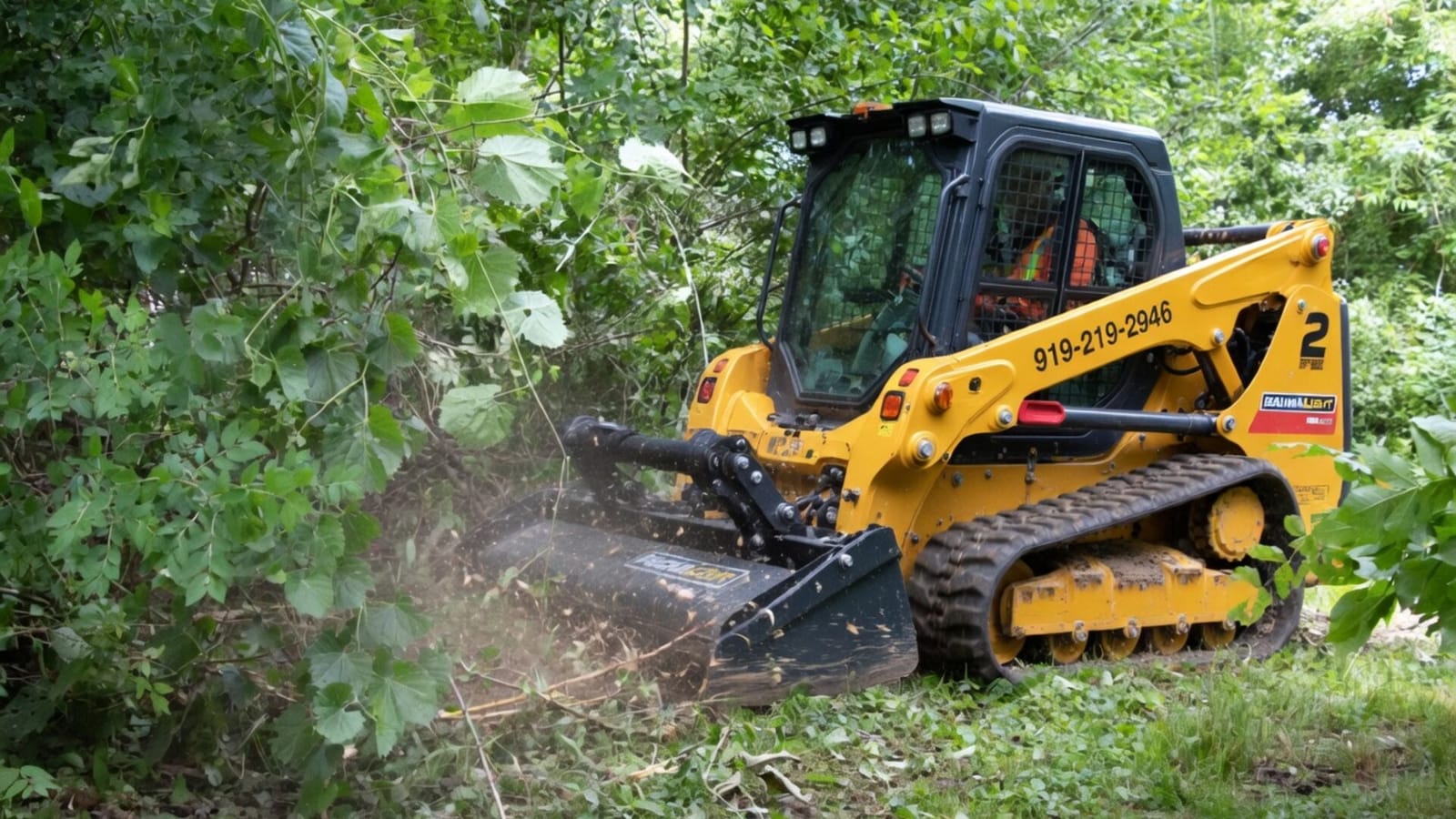
Our forestry mulcher is the first step, not the whole job. It grinds the vine mat, the brush and the smothered saplings inside it down to the ground and leaves the material in place, so your land, your fence line and your trees are back in view. Nothing is hauled off.
What it does not do is kill the crowns. They stay in the soil, and in warm weather they push new growth fast. The first season’s regrowth can come on hard. It is expected, and it is what the return cuts are for.
Before we quote a kudzu job, we walk it to see what the mat is hiding. Old fence wire, dumped debris, stumps and steep banks all slow the machine, and a mat over a creek bank or a drop-off changes how we work it. Where kudzu shares the ground with privet, honeysuckle and briers, the same mulching pass takes all of it; our guide to Chinese privet removal in NC covers what that plant needs afterward.
How Long Does It Take to Get Rid of Kudzu?
Plan in years. Our invasive species removal schedule for kudzu looks like this:
| Stage | When | What happens |
|---|---|---|
| First clearing | Any time of year | The mulcher clears the mat; crowns stay in the ground |
| Regrowth cuts | Through the growing season | Cutting ideally every 2 weeks weakens the crowns |
| First return cut | 3 to 6 months after clearing | We mulch the regrowth |
| Second return cut | About 12 months after clearing | We cut whatever survived |
| Watching | Every season after | Any new runner gets cut before it roots |
How long the watching lasts depends on the stand. A small patch less than 10 years old can be eliminated by persistent mowing or weeding over 3 to 4 years. A well-established stand may take as long as ten. On old stands, cutting alone is likely to fail or to need many years of intensive work; it works far better combined with herbicide, which is where a licensed applicator comes in.
One more thing to plan for: after herbicide, regrowth from surviving crowns may not show until two years later. A clean summer is a good sign, not the finish line. Keep walking the patch.
Pro tip: Never drag freshly cut green vines onto bare, moist ground or pile them at the edge of the clearing. Kudzu roots where its nodes touch soil, so a careless brush pile can start a new patch. Leave the mulched material where the machine spread it.
When Should You Cut or Spray Kudzu in Central NC?
The first clearing can happen in any month. What matters is what follows it.
- Cutting in the growing season: as often as you can, with every 2 weeks the ideal. Each flush of leaves you remove is energy the crowns spent and did not get back.
- If you can only cut once a year: do it in early fall, September in most areas. That is the single pass that hurts the plant most.
- Herbicide: most effective when applied after late May. Dormant-season herbicide appears to be ineffective, so a winter spray wastes a season.
- Where advice differs: Extension guidance in western North Carolina leans the other way on spray timing, urging work early in the growing season, while the vines are young and actively growing, and not waiting too late in the year. The licensed applicator you hire makes that call for your patch.
Winter is still useful. Frost drops the leaves, the crowns and the patch edges are easier to see, and a winter clearing means you start spring on bare ground instead of under a head-high mat. Just do not mistake brown winter vines for a dead patch; the roots are waiting for warm weather. For how the seasons affect clearing work in general, see our guide to the best time of year to clear land in NC.
What Can I Do About Kudzu Coming From Next Door?
Kudzu does not stop at a survey line, and a patch on a vacant lot next door will keep sending runners onto your side every summer. Because every crown has to die for the patch to stay gone, you cannot finish the job on your side alone while live crowns sit a few feet over the boundary.
What you can do on your own land:
- Clear a buffer strip. We mulch a strip along your side of the line, wide enough to walk and mow, so runners crossing over are easy to see.
- Cut that strip every season. Runners that cross get cut before their nodes root. A brush hog or mower keeps a cleared strip short once the mat is gone; our fence line clearing service is built for this kind of boundary work.
- Talk to the owner. If the neighbor or the lot’s owner agrees, both sides can be cleared on the same visit, which is the only way to reach the crowns that feed your side. We only work land the owner has asked us to clear.
If the kudzu sits uphill of your garden and someone is weighing chemical treatment, raise that with the licensed applicator before any spraying. What is downhill is part of their decision.
Frequently Asked Questions
What kills kudzu permanently?
No single treatment does, and we never promise kudzu is gone for good. It is brought under control by killing every root crown through repeated cutting, herbicide applied by a licensed applicator, or both, over several growing seasons. Even then it can come back from neighboring land, so plan on walking the edges every year.
How well does bush hogging tall kudzu work?
One pass with a brush hog cuts the tops and leaves every crown alive, so the patch looks the same within weeks of summer weather. Long vines in a tall first cut can also wrap a rotary cutter, which is one reason we open a mat with the mulcher. Once the regrowth is short, a brush hog or mower cutting it every couple of weeks is a cheap way to keep the pressure on.
Can goats get rid of kudzu?
They can, slowly. Grazed to the ground year after year, kudzu can’t recover after a few years and dies. Goats suit owners who can keep them on the patch season after season.
Can I dig kudzu out by hand?
On a small area, yes: dig out the root crown, not just the vine. On anything larger, the crowns are too many and too deep, and cutting plus a licensed applicator’s follow-up is the practical route.
How much does kudzu removal cost in NC?
The first clearing prices like other mulching work: our published starting point is around $1,500 an acre, and most residential clearing falls between $1,500 and $4,500 an acre, depending on how dense the mat is and what is buried in it. A small backyard patch may fall under brush clearing, which starts around $1,200 a project. Return cuts are smaller visits; our recurring property maintenance starts around $400 a visit. Herbicide is priced separately by the applicator. For how kudzu compares with other invasive plants on Piedmont land, see our landowner’s guide to invasive plants in Central NC.
Get Your Kudzu Under Control
We clear kudzu across Central North Carolina, from Raleigh and Durham to Garner and the rural land around them, and we set up the return cuts that keep the pressure on. Request a free quote and our crew will contact you to talk through the property, access and the clearing you need, including the honest multi-season part. You can also call (919) 525-3950.
Related Services
Learn more about the services mentioned in this article.


Serving These Areas
We provide land clearing services in these towns and surrounding areas.
More from the Cut Brush Blog
Keep reading for more tips and guides on land clearing.
 Services
 Bamboo Removal in NC: Timeline, Buffers and Neighbors
Bamboo removal in NC takes two to three years: cut the grove, then keep cutting or treating regrowth. Who does what, creek buffers and neighbor limits.
Services Wisteria Removal in NC: How to Kill It and Save Your Trees
Wisteria removal in NC: how invasive Chinese wisteria strangles mature trees, why pulling vines fails, and what removal costs. Get a free estimate today.
Services Tree of Heaven Removal in NC: Why You Don't Cut First
Tree of heaven removal in NC: identify the invasive Ailanthus, the spotted lanternfly link, why cutting first backfires, and what removal costs. Get a quote.
Let's Get Started on Your Land
Request a free quote. We'll contact you to discuss your property, access, and the clearing you need.
Get a Free QuoteOr call us directly: (919) 525-3950